The Clock Starts When the First Person Stands
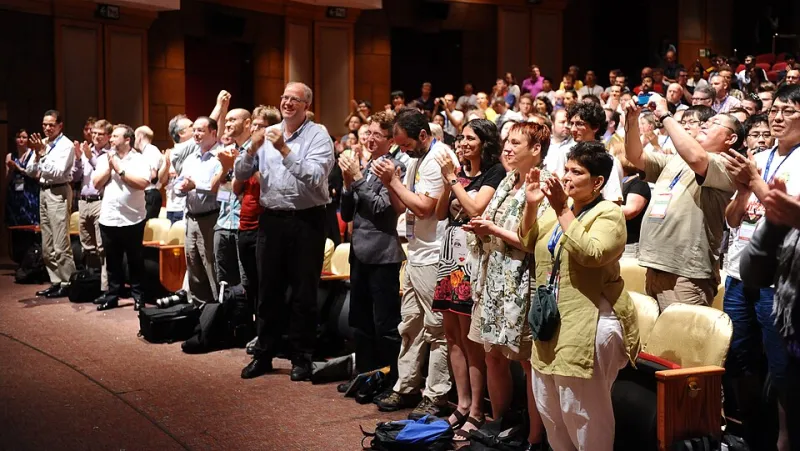
Photo: Niccolò Caranti, CC BY-SA 3.0, via Wikimedia Commons
There is a moment, about ninety seconds into the credits at a packed awards-season screening, when the room stops being a room and becomes a focus group with better clothes. The film is over. The lights are still low. And then someone stands.
Not everyone. Not yet. The first person is almost always the tell. Maybe it is a producer who has been gripping the armrest since the second act. Maybe it is a publicist who knows the camera placement. Maybe it is an actor from the film, seated just far enough back to seem surprised. The first stand is not a review. It is a cue.
The First Row Is the Tell
In Hollywood, standing ovations are not purely spontaneous. They are social events with a hierarchy, a rhythm, and a set of unwritten instructions that get passed around before the screening like a call sheet. Who stands first matters. So does who stands second. And so does who remains seated long enough to make the point that they are not impressed.
I have watched enough of these rooms to know that the first stand usually comes from someone with something at stake. A financier. A festival programmer. A lead actor’s manager. A publicist who has already calculated how the moment will look in a phone video. The first stand is not always fake. But it is almost always strategic.
The second wave is where the room starts to negotiate. If enough people follow, the ovation becomes real in the way that a rumor becomes real when enough people repeat it. If the second wave stalls—if people shift in their seats, check their watches, wait for someone more important to move—the first stander is left doing a lonely little half-squat that everyone will pretend not to remember.
A Standing Ovation Has a Runtime
The length of the applause is the part nobody talks about on the record and everyone talks about at the after-party. A polite ovation runs maybe forty-five seconds. A serious ovation crosses the ninety-second mark. A frontrunner ovation hits two minutes. Anything past three minutes is either genuine transcendence or a hostage situation.
Publicists coach clients on this. Not in a formal memo, usually. More like a pre-screening text: “Stand, but don’t be first.” Or “Clap through the credits, not just the names.” Or “If you’re seated near the aisle, don’t leave until the lights come up.” The notes sound absurd until you realize that a single clip of the room can travel farther than a trailer. In 2026, the ovation is content. The clock is the message.
The tricky part is that an ovation can overstay its welcome. A two-minute clap for a movie that is merely fine reads as anxiety, not enthusiasm. A three-minute clap for a film with no distributor can look like a negotiation happening in public. The room knows. The room always knows.
What the Clock Actually Buys
A long ovation does not guarantee an Oscar. It does, however, give a campaign something to point to. “Audiences stood for four minutes” is a sentence that can be printed on a postcard, posted on social, and repeated in a meeting. It is social proof with a timestamp.
It also buys leverage. A star who gets a standing ovation at a premiere has a slightly different posture in a negotiation the next morning. A director who watches the room rise has a slightly better case for final cut. A producer who engineered the moment has a slightly louder voice in the next financing conversation. None of this is written down. All of it is understood.
The ovation is not a review. It is a temperature check. And in a town that runs on momentum, temperature is a currency.
The Publicist’s Notes
The coaching is real, even if nobody admits it. Clients are told when to stand, how to clap, and where to look. They are told not to check their phones during the credits. They are told not to be the first one out the door. They are told that a standing ovation is a group activity, not a solo performance.
There is also the matter of the Q&A. A standing ovation that bleeds into a Q&A can make the whole event feel like a coronation. A standing ovation that ends too abruptly can make the Q&A feel like a deposition. The room reads the transition. So does the talent.
When the Applause Is a Warning
Sometimes the ovation is not a celebration. It is a warning. If the clap is too fast, too loud, too eager, it can read as relief. If the room stands but nobody looks at each other, it can read as obligation. If the first stander is the only one standing for a beat too long, it can read as a favor.
The negotiation is not always about a deal. Sometimes it is about a review, a tweet, a dinner conversation. Sometimes it is about whether a star will take a meeting. The ovation is a way of saying something without saying it. And in Hollywood, that is often the most useful language available.
The Exit Is Part of the Performance
The ovation ends, but the performance does not. Who leaves first? Who lingers? Who stands in the aisle talking to the director? Who walks out with the studio executive? The exit is part of the read. So is the after-party. So is the next morning’s text.
By the time the lights come up, the room has made a decision. It may not be the decision the filmmakers wanted. It may not be the decision the publicists predicted. But it is a decision. And the clock started when the first person stood.